 N

Trending: Pakistan celebrates historic first manned spaceflight with Chinese launch Hottest news
Muhammad Zeeshan Ali became Pakistan's first astronaut as a joint mission with China lifted off from Jiuquan on 25 November 2026.
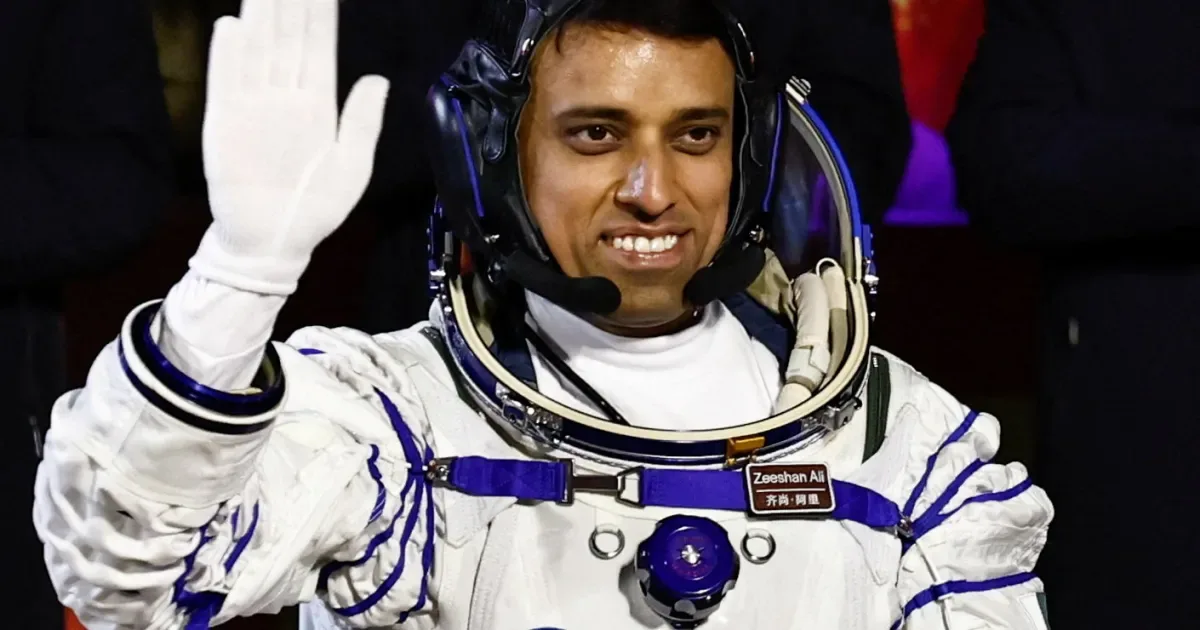 Image: Al Jazeera Download
On 25 November 2026, at 5:18 am local time (00:18 GMT), Pakistan witnessed its first manned spaceflight when Air Force pilot Muhammad Zeeshan Ali boarded a Chinese Long March‑2F rocket that rose from the Jiuquan Satellite Launch Centre in northwest China. The launch was streamed live at the headquarters of the Pakistan Space & Upper Atmosphere Research Commission (SUPARCO) in Islamabad, where a packed audience gathered before dawn.
Launch, crew and immediate reactions
The Chinese vehicle also carried two Chinese astronauts, Tang Hongbo and Wu Yi, alongside Ali, a 40‑year‑old pilot. As the rocket ignited, the national anthem played and the crowd rose in unison, chanting “Pakistan Zindabad.” After the vehicle cleared the launch pad, the auditorium fell silent for several minutes while the rocket appeared as a distant speck on the screen.
According to Al Jazeera, Breaking News, World News and Video from Al Jazeera, the Shenzhou‑24 spacecraft separated from the booster about ten minutes after liftoff and entered orbit. Later that morning, the craft docked with China’s Tiangong space station at 8:56 am (03:56 GMT), with the crew expected to enter the station around 11:45 am (06:45 GMT).
Among the spectators, 21‑year‑old physics student Zainab Abbasi recalled that she had taken out her phone to record the event but became so absorbed in the moment that she never pressed record. She later described a mix of anticipation and anxiety during the silent interval.
Public enthusiasm and personal stories
Students from the National University of Sciences and Technology (NUST) arrived before 5 am, some standing on the floor when seats filled up. Tayyaba Riaz, a final‑year mathematics student, said she reached the venue at 4:20 am and felt she was witnessing history. Many attendees held cards with Ali’s portrait in a spacesuit and paper flags of Pakistan and China, while green and white balloons decorated the stage.
Abbasi, who has been involved with the amateur group PakAstronomers since early 2018, traced her fascination with space to a childhood cartoon that sparked an interest in constellations. She noted that, as a child, becoming an astronaut seemed a distant dream reserved for Americans, not Pakistanis.
Ahzam Farooq, a physics undergraduate and vice‑president of the NUST astronomy society, recalled waking at 3 am for previous launches and hearing his parents dismiss the possibility of Pakistani astronauts. He now sees the collaboration with China as a shortcut that allows Pakistan to use existing platforms while developing its own satellite and research capabilities.
Adan Athar, a second‑year space sciences student at the Institute of Space Technology, said her family’s support fuels her ambition to become the next astronaut. Saif‑ul‑Islam Qureshi, a 72‑year‑old electronics engineer who helped found PakAstronomers, reflected that the launch symbolised more than Ali’s seat; it represented the aspirations of Pakistan’s younger generation.
Future ambitions and next steps
In a pre‑launch address, SUPARCO chairman Muhammad Yousaf Khan stated that Pakistan’s goals extend beyond this mission, with a target to reach the moon by 2035. He added that a lunar rover is planned for launch in 2028, marking the first step toward a crewed lunar program.
Khan told Al Jazeera after the launch that Pakistan can learn from China’s achievements and progress step by step toward similar milestones.
“If the Chinese people have reached here, there is no shortcoming in us. I believe one day, we too will reach that stage, if we keep moving step by step,” Khan said.
The successful docking of Shenzhou‑24 and the presence of a Pakistani astronaut on board have sparked optimism among students, hobbyists and officials alike. As the nation celebrates this landmark event, the partnership with China is expected to accelerate Pakistan’s entry into deeper space exploration.
What happens next
- Shenzhou‑24 is slated to remain attached to Tiangong for several weeks, conducting joint scientific experiments.
- SUPARCO plans to leverage the mission to develop indigenous satellite technology and train additional astronauts.
- The lunar rover project, aimed for a 2028 launch, will be a key milestone toward the 2035 moon‑landing goal.
Further reading
For more context on this story, explore these trusted outlets.